Evaluator Brief Test
Ask an independent colleague to review one priority public path and explain the problem, audience, proof, distinction, and useful next step in plain language.
Next move: Repair the single answer that was unclear.
Now available
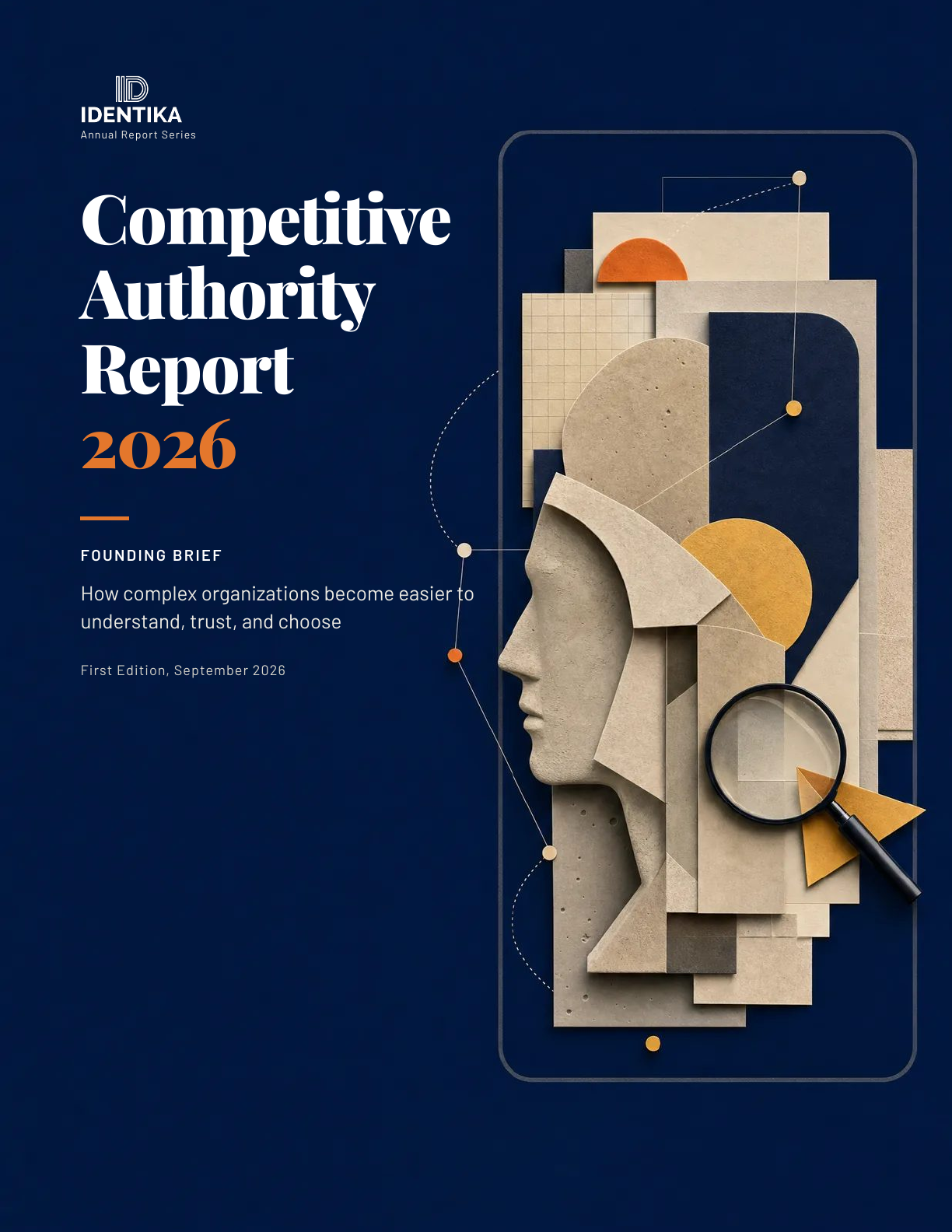
How complex organizations become easier to understand, trust, and choose.
First edition, September 2026
Research-led field guide for leaders of high-consideration B2B and government-contractor organizations. The PDF is tagged and text-accessible.
Competitive authority is the degree to which an organization is understandable, credible, and easy to advance when an evaluator is forming an opinion. It is not the same as brand awareness, follower count, or a polished identity.
This Founding Brief identifies four research-led conditions shaping competitive authority in the United States during 2026. A separate government-market context addresses public-policy status, not a general market trend.
Scope: This is a concise field guide, not a market-size study, vendor ranking, procurement guide, legal or compliance opinion, investment recommendation, or CAF training manual.
Each finding links current evidence to a bounded practical implication. The full reasoning, citations, scope notes, and reader tools appear in the report.
01
Practical implication: Make the organization easy to understand, verify, and explain to others.
02
Practical implication: Build helpful evidence paths, not generic content volume.
03
Practical implication: Treat a complete authority system as the baseline an evaluator expects.
04
Practical implication: Apply the same proof discipline to AI and innovation claims as to every other material claim.
The Competitive Authority Framework is Identika’s organizing lens. It supports a practical examination of public evidence without ranking individual organizations or predicting outcomes.
Can an evaluator understand the organization’s relevant value and context without decoding jargon?
Is there a specific, defensible point of view or reason to remember the organization?
Can a stakeholder find evidence that is credible, current, and appropriately scoped?
Is relevant expertise and proof easy to find through ordinary public paths?
Do capability, leadership, proof, and experience reinforce one another?
The purpose is not to create more content. It is to connect a real evaluator question to a defensible improvement.
Ask an independent colleague to review one priority public path and explain the problem, audience, proof, distinction, and useful next step in plain language.
Next move: Repair the single answer that was unclear.
Follow one high-value evaluator question through four stages: find, understand, verify, and continue.
Next move: Improve one broken handoff in the path.
Map one priority offer across Clarity, Distinctiveness, Proof, Visibility, and Consistency.
Next move: Assign one owner, one evidence source, and one review date to the most consequential gap.
Review five material public claims against source, date, scope, method, and owner.
Next move: Qualify or remove one claim that lacks a usable evidence record.
Begin with an evaluator question that matters to a real decision, not with a channel or a campaign.
Choose one priority audience question. Create a plain-language evaluation brief.
Trace the public evidence path. List gaps across the five diagnostic signals.
Fix one consequential gap. Improve a proof asset, explanation, pathway, or accessibility issue.
Test and record. Gather independent feedback and update the claim-to-proof record.
The inaugural report combines direct-source review, a structured public-category review, and selected Identika case examples. It identifies practical signals rather than ranking organizations.
The full PDF includes the complete source list, scope notes, case-example references, research timing, and limitations.
Start with one consequential audience question. Build a path from a clear answer to relevant proof and a useful next step. Improve it, observe how it is used, and repeat.